Contact Us Distributors Downloads

Engineering

Nabtesco's cycloidal gear technology offers higher shock resistance and lower backlash than traditional planetary and cam indexing devices.
Home Engineering
Nabtesco’s Cycloidal Gear Technology

Nabtesco’s Cycloidal Gear Technology

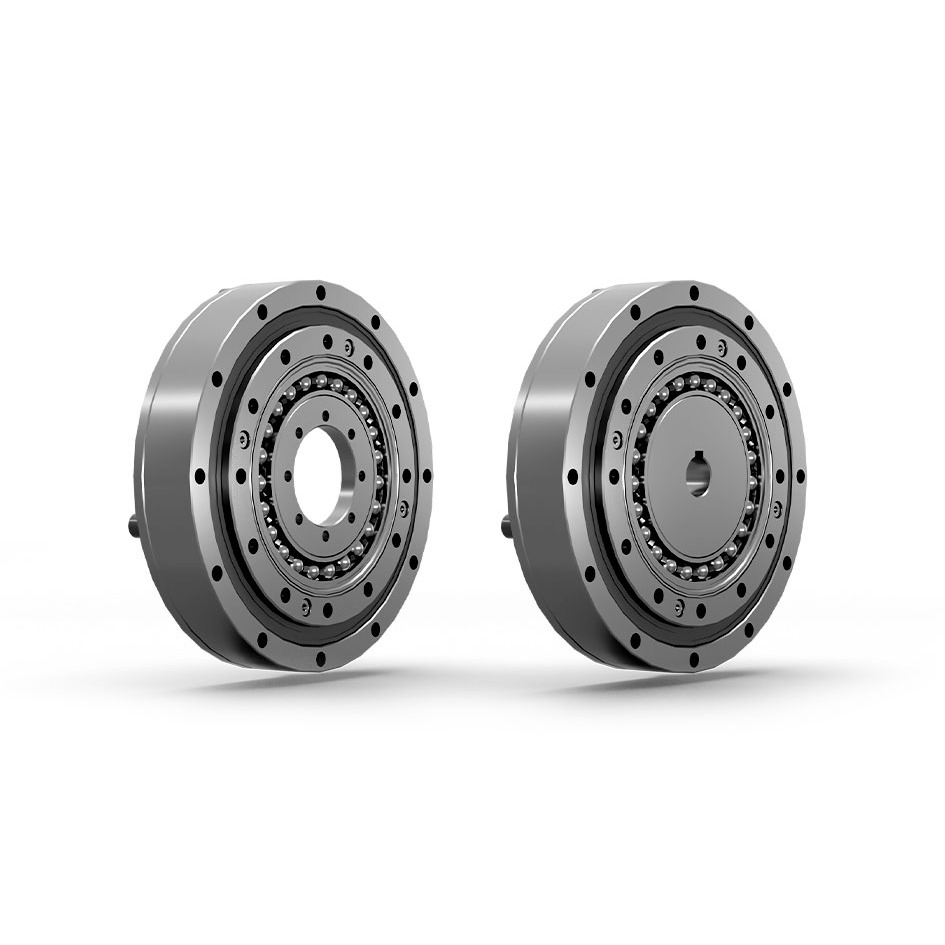
The Nabtesco reducer is a patented two-stage cycloidal design that provides large torque, high ratios and significant shock-load capability with extreme precision and excellent quality. The RV gear uses rolling contact elements to reduce wear, extend life and lower backlash, and the pin and gear structure of the cycloidal design gives higher shock resistance than traditional reducers while reducing backlash further. A set of large, internal angular support bearings provides large moment capacity and removes the need for external support devices. Hollow shaft models reach ratios of up to 300:1 without stacking stages in the manner of a planetary gearbox, so they can have a more compact footprint.

Main Features

Performance highlights of the patented two-stage cycloidal RV gear.

Near Zero Backlash

Less than 1 arc-min.

High Repeatability

Typically 20-30 arc-sec.

Large E-Stop Capacity

5x rated torque

High Ratio Availability

Up to 300:1 for hollow shaft gearboxes

High Torsional Rigidity

Very stiff performance

Hollow Shaft Options

Up to 5″ diameter through hole

Planetary vs. Cycloidal

Get access to the white paper.
Download

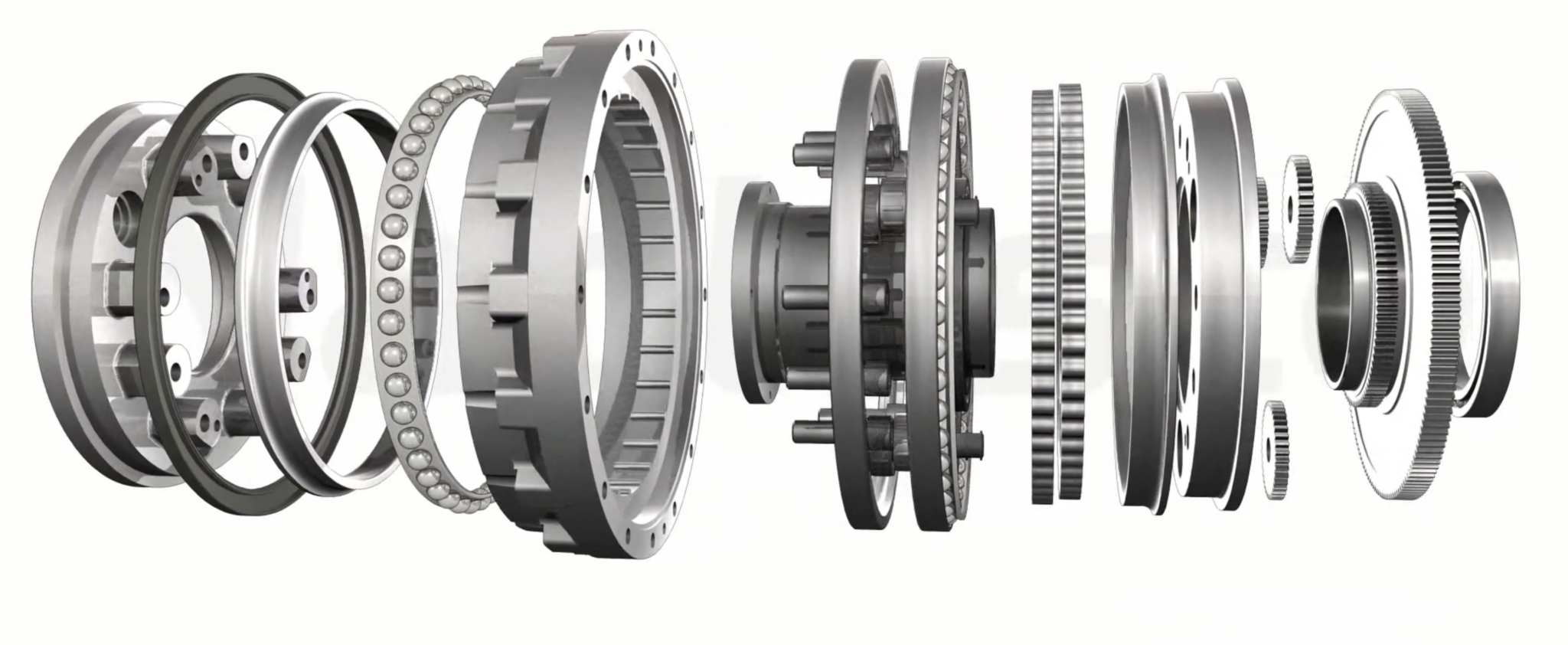
Patented 2-Stage Cycloidal Gearbox

  • Integrated Angular Ball Bearings
    Allow for support of external loads
    Increase rigidity and allowable moment
  • 2-Stage Reduction Mechanism
    Reduces vibration: slower rotational speed of the RV gears
    Reduces inertia: smaller input coupling (input gear)
  • Dual-Sided Crankshaft Support
    High torsional stiffness, lower vibration and high shock-load capability
  • Rolling Contact Elements
    Excellent starting efficiency
    Low wear and longer life
  • Pin And Gear Structure
    Higher shock resistance than traditional reducers
    Further reduces backlash
  • Continuous Gear Teeth Contact
    Very low backlash (less than 1 arc-min)
    Higher shock-load capability (5x rated torque)

RV Gear Mechanism

First Stage

First Stage

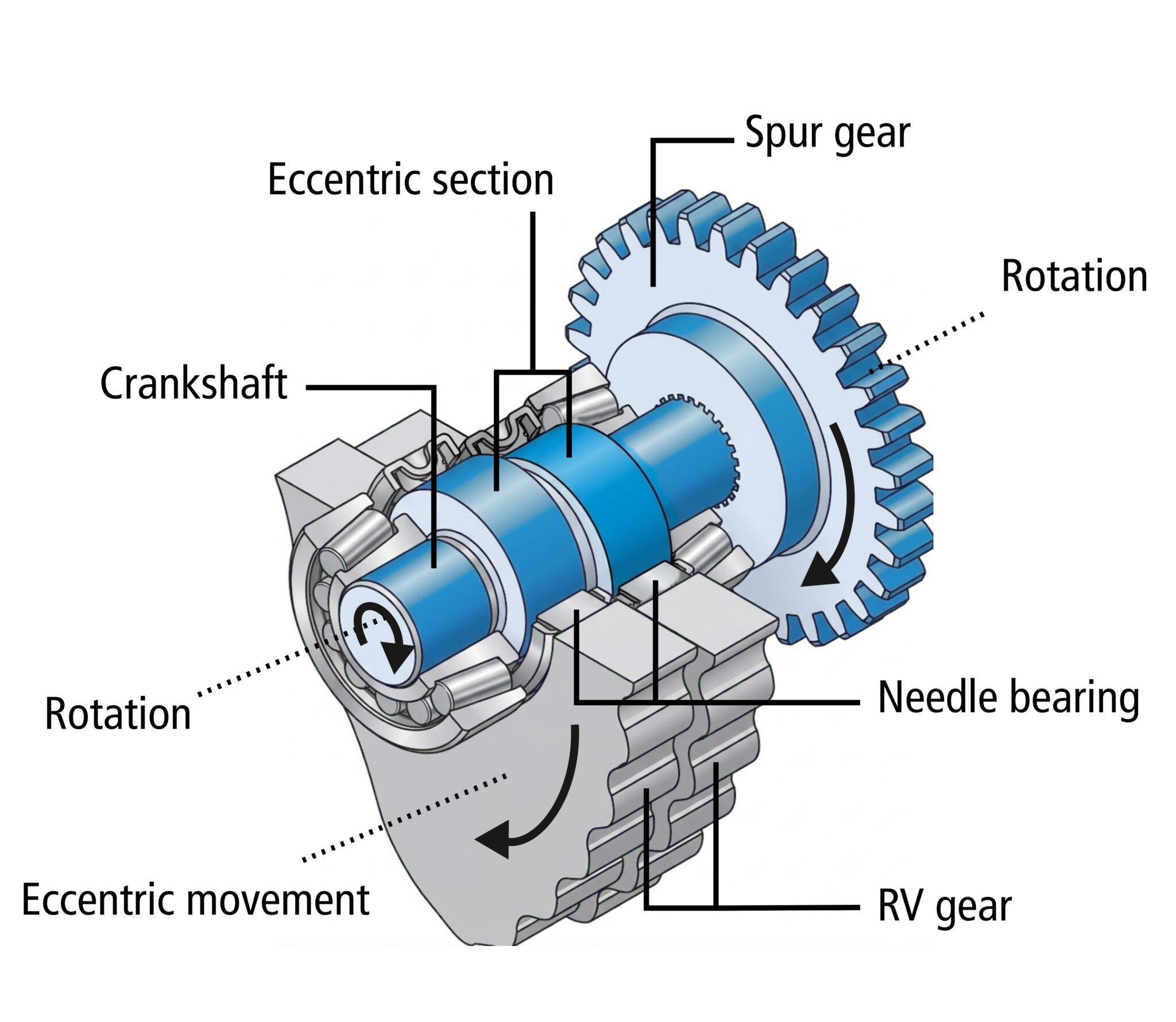
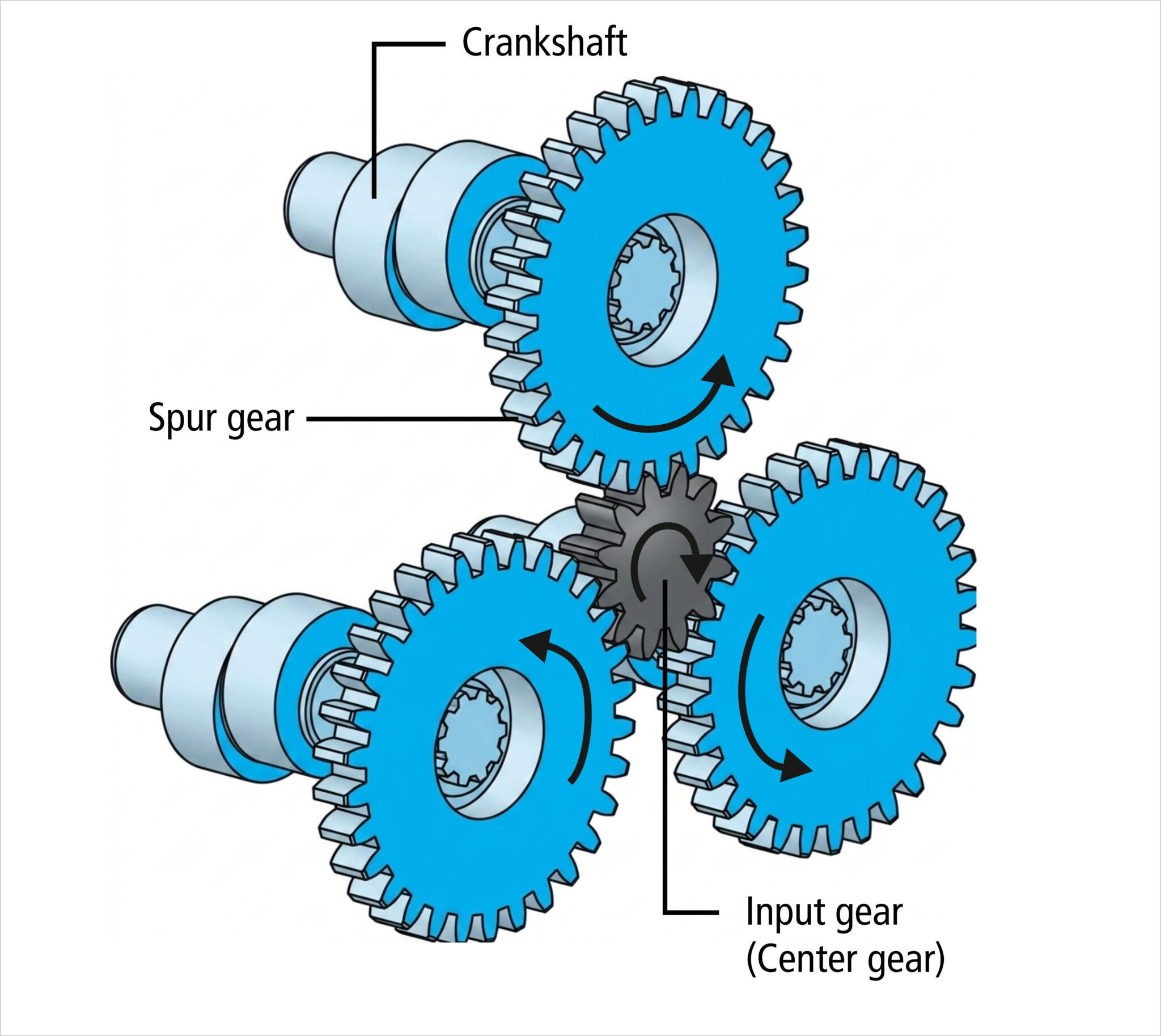
The servo motor rotation is transmitted through the input gear to the spur gears, with the speed reduced accordingly. Crankshafts, which are directly connected to the spur gears, rotate at the same speed.

Second Stage

Second Stage

Two RV gears are mounted to the eccentric region of the crankshaft (2 RV gears are used to equally balance forces and to provide continuous teeth contact). As the crankshafts rotate, the two RV gears also revolve. One complete crankshaft rotation causes the RV gears to revolve one pitch of a pin, with all of the RV teeth in constant contact with all of the pins. The pins are arrayed at a constant pitch in the grooves of the gearbox and the number of pins is one larger than the number of teeth. This rotation is then transmitted to the output of the gearbox via the crankshafts at a speed reduced in proportion to the number of pins. The total reduction ratio is equal to the first reduction ratio multiplied by the second reduction ratio.

Strain Wave Gear Mechanism

Operating Principle

Operating Principle

A strain wave gear gets by with only three parts: the wave generator, the flexspline and the circular spline. What sets it apart from conventional gearing is that torque travels through a deliberately elastic member. The wave generator bends the thin-walled flexspline into an oval, so a large number of its teeth engage the circular spline at once, in two zones on opposite sides. Sharing the load across so many teeth is what gives the gear zero backlash, precise positioning and high torsional stiffness.

In most drives the motor turns the wave generator, which acts as the input, while the output is taken from the flexspline or, in some layouts, from the circular spline. The flexspline is cut with two teeth fewer than the circular spline, and that small mismatch is the source of the reduction.

Wave Generator

Wave Generator

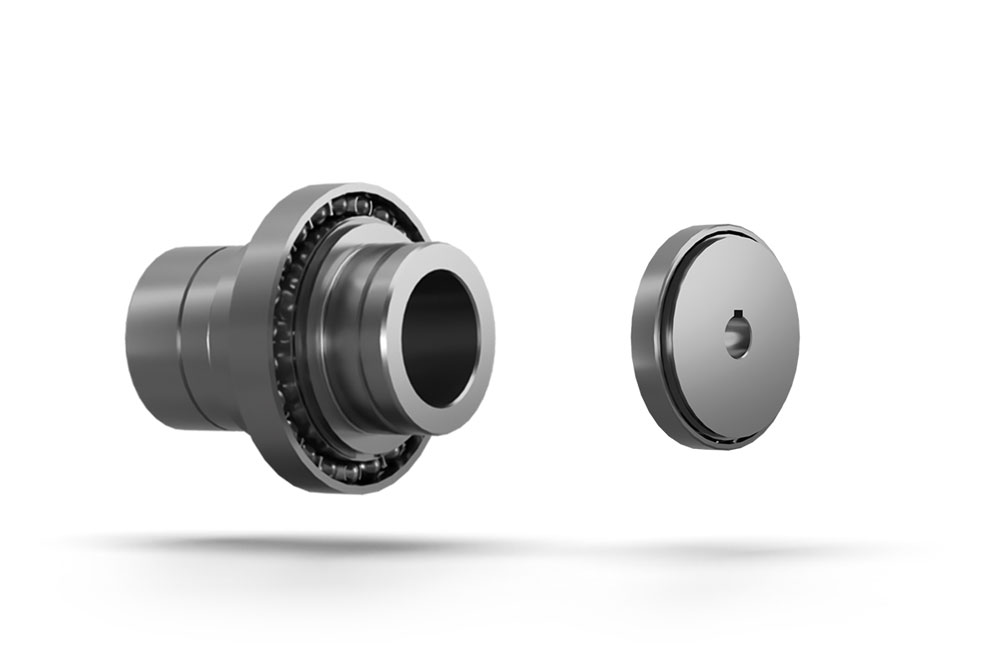
The input element. An elliptical hub is fitted with a thin ball bearing whose races can flex radially, so the bearing takes on the oval shape of the hub while still turning freely. Pressed into the flexspline, the wave generator pushes it outward along the long axis of the ellipse and lets it relax along the short axis. Rotating the hub sends this elastic deformation around the flexspline like a traveling wave, which is where the gear gets its name.

Flexspline

Flexspline

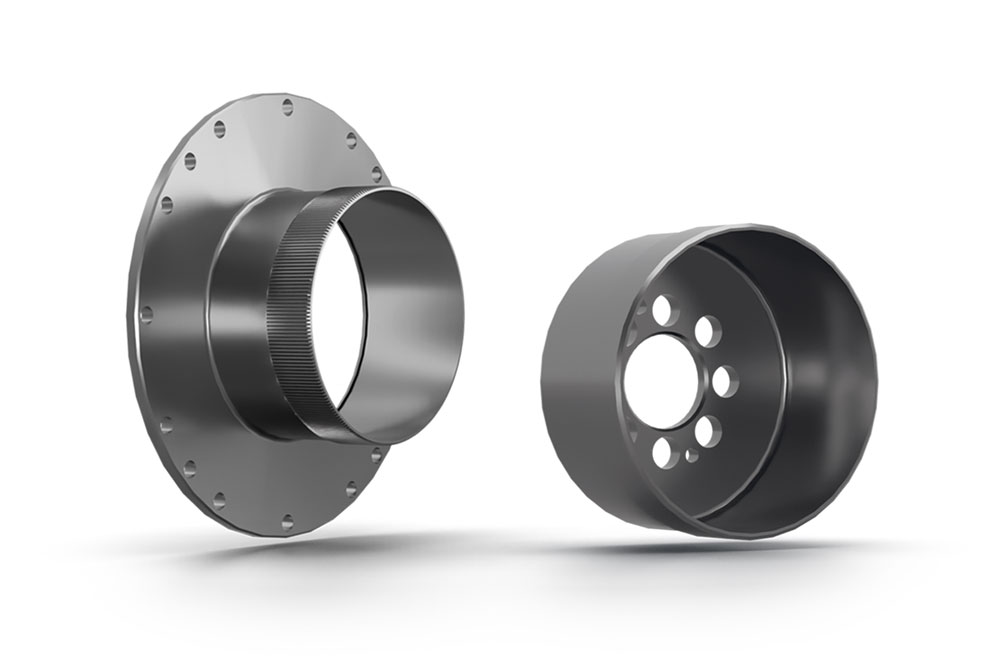
The flexible element. A thin-walled steel sleeve, built as a cup or a flanged hat shape, with gear teeth cut around the outside of its open end. It is stiff in torsion yet elastic in the radial direction, so it follows the oval profile of the wave generator turning inside it. Its tooth count is two lower than that of the circular spline, and in the most common arrangement the flexspline is also the output member.

Circular Spline

Circular Spline

The rigid element. A solid steel ring with teeth machined into its inner diameter. Because the flexspline is stretched into an oval, its teeth reach the circular spline only near the two ends of the long axis, where they mesh fully; along the short axis they stand clear. The circular spline is usually bolted to the housing as the fixed member, or it becomes the output when the flexspline is held instead.

How The Reduction Works

How The Reduction Works

Turning the wave generator rotates the long axis of the ellipse, and the two engagement zones travel around the circular spline with it. As each zone moves on, flexspline teeth lift out of one tooth gap and settle into the next.

With two teeth fewer, the flexspline slips back one tooth against the circular spline for every half turn of the wave generator and two teeth for every full turn, moving opposite to the input. When the circular spline is fixed, the ratio equals the flexspline tooth count divided by two, so a 200-tooth flexspline delivers 100:1 in a single stage.

The payoff is a compact, lightweight gear with zero backlash, excellent repeatability, high torque capacity for its size, long maintenance-free service and room for a hollow center shaft.

How Can We Support You?

Here for engineers and robot technicians.
Designing machines, servicing robots or building mechatronic systems? Our application engineers help you select, size, integrate and maintain the right gear.